
Transferring rental history to a new landlord is defined as providing verified documentation and references that prove your payment record and conduct as a tenant. This process, formally called rental history verification or landlord tenant history transfer, gives your new landlord the evidence they need to approve your application with confidence. Federal law under the Fair Credit Reporting Act (FCRA) governs how tenant information is shared, requiring written authorization before any rental records change hands. Getting this right from the start saves you time, protects your privacy, and puts your best foot forward with a new landlord.
What documents do you need to transfer rental history?#
The rental history transfer process starts with gathering the right paperwork before you contact anyone. Walking into this without your documents ready is the fastest way to create delays that cost you the apartment.
The core documents you need include:
- ✅ Signed lease agreements from previous rentals, showing your name, address, and tenancy dates
- ✅ Rent payment receipts or bank statements confirming on-time payments
- ✅ A landlord reference letter from each previous landlord, confirming tenancy, payment history, and move-out condition
- ✅ A written tenant authorization form giving your previous landlord permission to release your rental records
- ✅ A completed rental verification form that your new landlord may require
The written authorization is the piece most renters skip, and it is the most legally significant. A signed release protects your previous landlord from defamation liability and should be retained for at least 3 years. Without it, many landlords and property managers will refuse to share any information at all, citing privacy law.
Pro Tip: Prepare a single authorization document that names both your previous landlord and your new landlord. This covers the release in one step and avoids back-and-forth paperwork.

A landlord reference letter should be on official letterhead and confirm tenancy dates, monthly rent amount, payment history, lease compliance, and the condition of the property at move-out. Keep copies of every signed letter and authorization together in one folder, physical or digital.
How to obtain and provide rental references step by step#
Once your documents are ready, the actual process of sharing rental history with a new landlord follows a clear sequence. Skipping steps or sending incomplete requests is the most common reason applications stall.
-
Contact your previous landlord directly. Call or email to let them know you are applying for a new rental and need a reference or verification form completed. Give them a heads-up before sending any paperwork.
-
Send your written authorization. Attach your signed tenant authorization form to every request. This gives your previous landlord legal cover to respond and speeds up the process.
-
Include all key details in your request. Specific tenancy details such as your rental address, move-in and move-out dates, and monthly rent save your previous landlord from doing extra research. The more complete your request, the faster you get a response.
-
Use a standardized form. A previous landlord reference form should request tenancy dates, payment history, lease compliance, and move-out condition. Using a template keeps responses factual and consistent, which protects both parties.
-
Follow up within 48 hours if you hear nothing. A polite follow-up email or call is appropriate. Reference your original request date and restate the deadline you are working toward.
-
Send completed references directly to your new landlord. Deliver them by email or through your new landlord's preferred application portal. Confirm receipt.
Pro Tip: Ask your new landlord upfront whether they prefer a reference letter, a completed verification form, or direct landlord contact. Matching their preferred format cuts processing time significantly.
The table below shows what each document type covers and how to deliver it:
| Document | What it covers | Best delivery method |
|---|---|---|
| Landlord reference letter | Tenancy dates, rent, payment history, move-out condition | Email or application portal |
| Rental verification form | Structured factual fields for landlord to complete | Email with authorization attached |
| Rent payment receipts | Proof of on-time payments | PDF attachment or printed copy |
| Lease agreement | Tenancy terms and address confirmation | Scanned PDF |
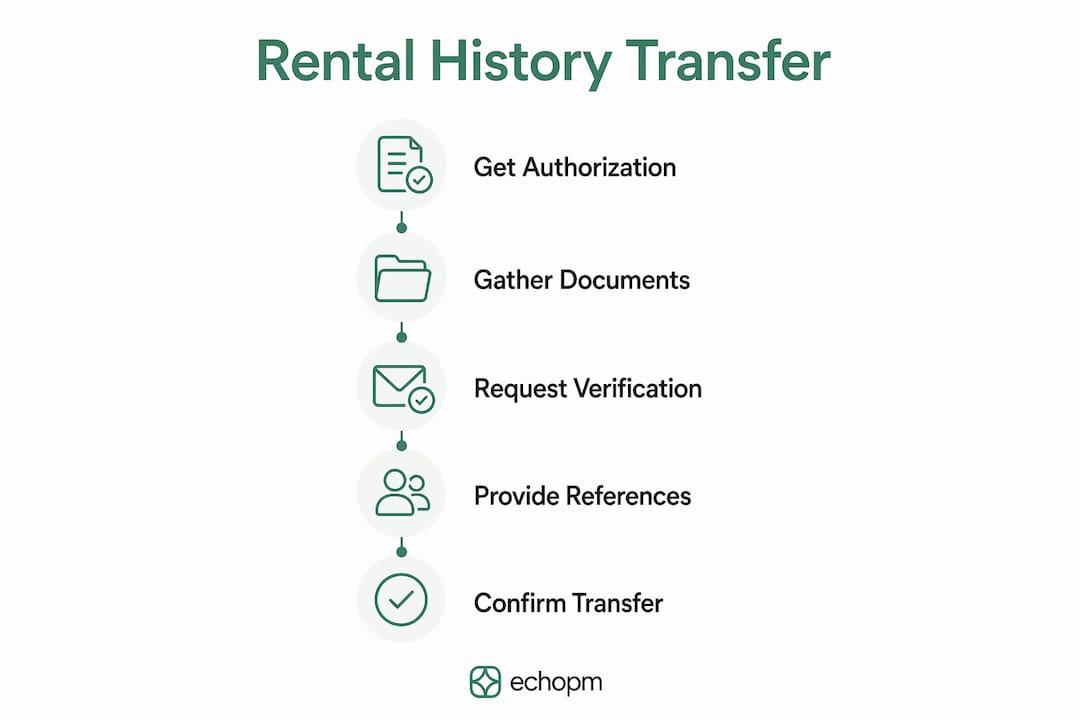
Rental verification typically completes within 1–3 business days once your previous landlord responds. That timeline means delays on your end, such as missing authorization forms, can push your application back by a week or more.
What do new landlords actually look for in your rental history?#
New landlords prioritize payment timeliness and property care above everything else. Personal character references from friends or coworkers carry far less weight than a direct landlord account of how you paid rent and treated the unit.
Landlord references are considered the strongest evidence of tenant reliability because they speak directly to financial responsibility and property conduct. An employer reference confirms income, but it says nothing about whether you paid rent on time or left a unit in good shape.
New landlords typically verify your rental history through two methods:
- Direct landlord contact: Your new landlord calls or emails your previous landlord to confirm the details in your reference letter or verification form.
- Tenant screening reports: These reports pull eviction history and credit checks and can look back up to 10 years. Late payments, lease violations, and property damage all appear here.
Beyond rental history, new landlords also weigh income verification and credit score. Most require gross monthly income of at least 2.5 to 3 times the monthly rent. A strong rental history can offset a borderline credit score, but it rarely compensates for a pattern of late payments.
The table below compares types of rental history evidence by the weight a new landlord typically assigns them:
| Evidence type | What it shows | Landlord weight |
|---|---|---|
| Landlord reference letter | Payment history, property care, lease compliance | Highest |
| Tenant screening report | Credit, evictions, background | High |
| Rent payment receipts | On-time payment record | Medium |
| Employer reference | Income stability | Medium |
| Personal reference | Character only | Low |
Common challenges when transferring rental history#
The biggest obstacle most renters face is a slow or unresponsive previous landlord. Property managers juggling multiple units often deprioritize reference requests, especially from former tenants.
Here is how to handle the most common problems:
- Unresponsive previous landlord: Send a written request by email and follow up by phone. Reference your application deadline clearly. If the landlord manages through a property management company, contact the company directly rather than waiting on an individual.
- Difficult landlord relationship: If you ended your tenancy on bad terms, prepare alternative proof. Rent payment receipts, bank statements, and your signed lease agreement can substitute for a reference letter in many cases.
- Incomplete rental history: If you are a first-time renter or have gaps in your history, offer additional documentation such as a co-signer, a larger security deposit, or proof of consistent income.
- Negative rental history: Address it directly with your new landlord before they find it themselves. A brief written explanation of the circumstances, paired with evidence of improvement, is more effective than hoping it goes unnoticed.
"Proactive tenants who maintain organized rental records and keep written authorizations ready to share quickly avoid most processing delays." — rental history best practices
Keeping a personal rental history file is worth the effort. Store your lease agreements, payment receipts, move-in and move-out inspection reports, and any written communications with previous landlords in one place. You can access renter resources through Echopm to help organize these records before your next application. When a new landlord asks for documentation, you can respond the same day instead of scrambling for paperwork.
Pro Tip: Take timestamped photos of every unit at move-in and move-out. These protect you from false damage claims and serve as supporting evidence if a landlord gives you a negative reference.
Key Takeaways#
Successfully transferring rental history to a new landlord requires written authorization, complete documentation, and direct communication with previous landlords before your application deadline.
| Point | Details |
|---|---|
| Authorization comes first | Always get a signed tenant authorization form before requesting any rental records. |
| Reference letters carry the most weight | Landlord reference letters outrank employer and personal references in tenant screening. |
| Verification takes 1–3 business days | Submit complete requests early to avoid delays that push back your application timeline. |
| Keep your own records | Store leases, receipts, and inspection reports so you can respond to any landlord request the same day. |
| Address negatives proactively | Explain past issues in writing before your new landlord finds them in a screening report. |
What I have learned from watching renters get this wrong#
Most renters treat rental history transfer as an afterthought. They apply for a new unit, then scramble to contact a previous landlord they have not spoken to in two years. By the time the reference comes through, the unit is gone.
The renters who move smoothly from one lease to the next treat their rental history like a professional portfolio. They keep it current, organized, and ready to share. They know their previous landlord's contact information before they need it. They have a signed authorization form ready to attach to any request. That preparation is not complicated. It just requires thinking ahead by a few weeks.
The other mistake I see constantly is renters assuming a good relationship with a previous landlord is enough. A verbal "I'll put in a good word" does not satisfy a landlord verification process that requires written documentation. Get everything in writing, every time.
Negative history is not a death sentence either. I have seen renters with one eviction on record get approved for quality units because they came prepared with a clear explanation, strong income proof, and a co-signer. Transparency paired with evidence of change works far better than hoping a landlord does not look closely.
The rental market rewards renters who communicate early, document everything, and make it easy for landlords to say yes. That is the whole game.
— Walker
Echopm makes rental history management easier#
Keeping your rental records organized and sharing them with a new landlord does not have to be a paper chase.

Echopm gives renters a centralized dashboard to manage lease documents, payment records, and landlord communications in one place. Landlords using Echopm's property management tools can request and verify tenant history directly through the platform, cutting the back-and-forth that slows most applications down. The platform eliminates application fees and connects renters with real-time listings from verified property managers. Whether you are preparing your first rental application or moving between units, Echopm gives you the tools to present your rental history clearly and get approved faster.
FAQ#
What is rental history verification?
Rental history verification is the process a new landlord uses to confirm your past tenancy, payment record, and conduct as a tenant. It typically involves direct contact with previous landlords and a review of tenant screening reports.
How long does rental history verification take?
Rental verification generally completes within 1–3 business days once your previous landlord responds to the request.
Do I need written authorization to share my rental history?
Yes. A signed tenant authorization form is required before a previous landlord can legally release your rental records to a new landlord. Skipping this step can delay or block your application entirely.
What if my previous landlord gives a negative reference?
Address it directly with your new landlord before they find it in a screening report. Pair a written explanation with strong income proof or a co-signer to offset the negative history.
How far back do landlords check rental history?
Landlords and tenant screening services can look back up to 10 years when reviewing eviction history, credit, and past tenancy records.