
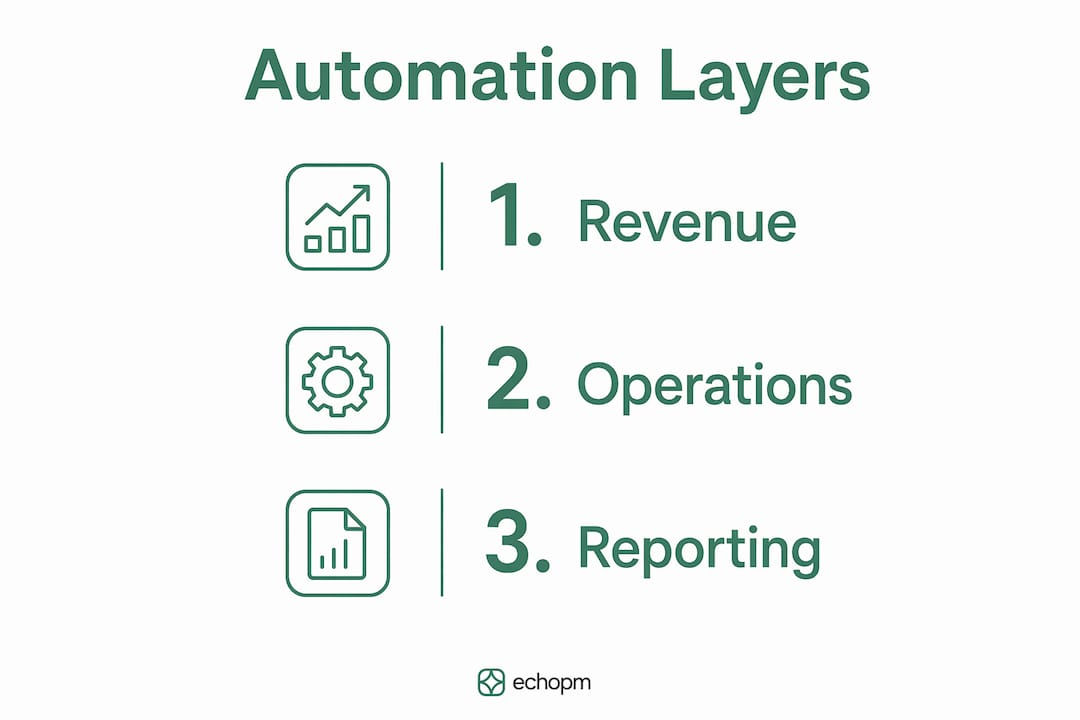
Multi-property management is the centralized oversight of multiple rental properties using integrated systems that coordinate leasing, maintenance, communication, and financial processes across all assets. Understanding how multi-property management works is the difference between a portfolio that grows and one that grinds you down. The industry standard for managing multiple properties at scale relies on a three-tier automation strategy: Revenue, Operations, and Reporting layers. Each layer handles a distinct function, and together they replace the fragmented, manual approach that burns out most landlords before they reach their fifth property.
How multi-property management works: the three core automation layers#
The three automation layers are not just a framework. They are the operational backbone of every portfolio that scales without chaos.
| Layer | Core Function | Key Benefit |
|---|---|---|
| Revenue | Rent collection, lease renewals, financial reconciliation | Consistent cash flow with fewer manual errors |
| Operations | Maintenance intake, vendor assignment, task tracking | Faster response times and reduced staff burden |
| Reporting | Real-time dashboards, performance metrics, portfolio analytics | Data-driven decisions across all properties |
The Revenue Layer handles everything that touches money. Automated rent collection removes the need to chase payments manually. Lease renewal reminders go out on schedule. Financial reconciliation happens in the background rather than at the end of a stressful month. Most lost profit in portfolios comes from manual errors and slow responses rather than low market demand. That single fact should change how you think about where to invest your time.

The Operations Layer manages the day-to-day work orders. Automated maintenance intake and vendor assignment significantly improve tenant satisfaction and reduce the burden on your staff. Instead of fielding calls, logging requests by hand, and texting vendors yourself, the system routes each request to the right person automatically. That is not a luxury at scale. It is a requirement.
The Reporting Layer gives you visibility. Real-time dashboards show occupancy rates, maintenance backlogs, and revenue trends across every property at once. Without this layer, you are making decisions based on memory and gut feel rather than actual data.
Automation should be phased, starting with the Revenue Layer to capture immediate cash flow gains, then moving to Operations, and finally Reporting. This sequence lets you see results quickly without overwhelming your team during the transition.
Pro Tip: Start your automation rollout with rent collection before touching maintenance workflows. You will see the financial impact within the first billing cycle, which builds confidence for the next phase.
How do standardized checklists improve management efficiency?#
Checklists are the unglamorous secret behind every well-run portfolio. Standardizing checklists for turnovers, preventative maintenance, and issue triage is non-negotiable if you want to prevent deferred maintenance and costly repairs. Without them, each property gets a different level of care depending on who is doing the work that day.
Most portfolios maintain stability by consistently using three core checklists to cover both routine and unexpected events. Here is what each one covers:
- ✅ Turnover checklist: Deep cleaning verification, unit inspection, appliance testing, lock changes, key handoff documentation, and photo evidence of condition before and after each tenancy.
- ✅ Preventative maintenance checklist: Scheduled HVAC filter replacements, plumbing inspections, roof and gutter checks, smoke detector testing, and exterior walkthroughs on a quarterly or seasonal basis.
- ✅ Issue triage checklist: Problem logging with timestamps, severity classification (urgent vs. routine), vendor contact, estimated resolution time, and follow-up confirmation with photos and invoices attached.
The photo and invoice requirement is worth emphasizing. Evidence-based task completion protects you legally, keeps vendors accountable, and gives you a paper trail if a tenant disputes a charge. A practical maintenance guide for landlords covers this in detail, including how to document issues before they become expensive problems.
Consistent workflows also reduce the cognitive load on your team. When every property follows the same process, a new hire or a substitute vendor can step in without missing a beat. That kind of consistency is what separates a scalable operation from a one-person juggling act.
Pro Tip: Attach your checklist directly to the work order in your property management system. When the checklist and the task live in the same record, nothing gets lost and accountability is automatic.
What operational practices support effective multi-property oversight?#
Centralized communication is the foundation of a well-run portfolio. Effective scaling requires managing work in three layers: Communication, Tasks, and Calendar, with clear ownership and proof of completion at every step. When these three layers are disconnected, you end up with missed messages, duplicate work, and tenants who feel ignored.
Here is how to structure each layer in practice:
- Communication layer: Route all tenant, vendor, and owner messages through a single inbox or platform. Avoid text threads and personal email accounts. Every message should be logged, searchable, and tied to a specific property or unit.
- Task layer: Assign every work order to a named person with a due date and a completion requirement. "Someone will handle it" is not an assignment. A task with no owner is a task that does not get done.
- Calendar layer: Maintain a unified calendar that shows lease expirations, scheduled maintenance, inspections, and vendor visits across all properties. Centralized booking calendars reduce fragmented operations and improve experiences for tenants, vendors, and property owners alike.
- Proof of completion: Require photos, notes, or invoices for every closed task. This is not about distrust. It is about having a record when questions arise weeks or months later.
- Escalation protocol: Define what triggers an escalation and who handles it. A leaking pipe at 11 PM needs a different response path than a broken cabinet hinge reported on a Tuesday afternoon.
The contrast between ad-hoc management and this structured approach is stark. Ad-hoc management means you are the single point of failure. Structured layered management means the system carries the load, and you step in only when judgment is required.
What are the benefits and challenges of multi-property management software?#
Property management software acts as the single source of truth for your entire portfolio. Full-stack automation connects your property management system, accounting, and tenant communication tools to reduce manual workload and improve real-time visibility across all properties. When these systems talk to each other, a completed maintenance job can automatically trigger a vendor payment without anyone touching a keyboard.
Portfolio-wide data consolidation supports smarter pricing, inventory management, and revenue decisions by allowing you to spot trends quickly. If one property has a 15% higher vacancy rate than the rest of your portfolio, you see it immediately rather than discovering it at year-end.
| Capability | What it does for you |
|---|---|
| Automated rent collection | Eliminates manual follow-up and reduces late payments |
| Maintenance dispatch | Routes work orders to vendors without staff intervention |
| Pricing synchronization | Adjusts rents across units based on market data |
| Real-time reporting | Shows portfolio performance at a glance, any time |
| Centralized communication | Keeps all tenant and vendor messages in one place |
The challenges are real, though. System integration is the most common friction point. If your accounting software does not connect cleanly with your property management platform, you end up with duplicate data entry, which defeats the purpose. User adoption is the second hurdle. A platform only works if your team actually uses it consistently. Data consistency is the third. Garbage in, garbage out. If lease dates, unit details, and contact records are not accurate from day one, your dashboards will mislead you.
The solution to all three is the same: start simple, train thoroughly, and audit your data before going live. Platforms like Echopm are built to unify these functions without requiring a technical team to manage the integration.
Key Takeaways#
Multi-property management works best when Revenue, Operations, and Reporting automation layers are implemented in sequence, supported by standardized checklists and centralized communication.
| Point | Details |
|---|---|
| Three-tier automation | Implement Revenue, then Operations, then Reporting layers for manageable, effective scaling. |
| Checklist standardization | Use turnover, preventative maintenance, and issue triage checklists across every property without exception. |
| Centralized communication | Route all messages through one system to eliminate fragmented operations and missed tasks. |
| Evidence-based completion | Require photos, invoices, or notes for every closed task to maintain accountability. |
| Phased software adoption | Start with rent collection automation before adding maintenance and reporting tools. |
What I have learned from watching portfolios succeed and fail#
The portfolios that struggle are almost never struggling because of bad properties. They struggle because the owner is treating each property as a separate business instead of one unified operation. I have seen landlords with two units more organized than investors managing twenty, simply because the two-unit owner built systems early and the twenty-unit investor never did.
The biggest mistake I see is skipping the Revenue Layer and going straight to fancy reporting dashboards. You cannot make good decisions from data if your cash flow is unpredictable. Fix the money first. Automate rent collection, get your lease renewals on a schedule, and reconcile your finances monthly. Everything else gets easier once the revenue side is stable.
The second mistake is treating checklists as optional. I know they feel bureaucratic when you are managing a small portfolio. But the moment you hand off a task to a vendor or a property manager and something goes wrong, you will wish you had a documented process to point to. Proof-based task completion is not about micromanagement. It is about having a system that works without you in the room.
Platforms like Echopm bring these layers together in one place, which matters more than any individual feature. The value is not in any single tool. It is in having one place where communication, tasks, finances, and reporting all live together.
— Walker
Echopm brings layered management to your whole portfolio#
Managing multiple rental properties does not have to feel like a constant fire drill. Echopm is built for property managers who want centralized control without the complexity of stitching together five different tools.
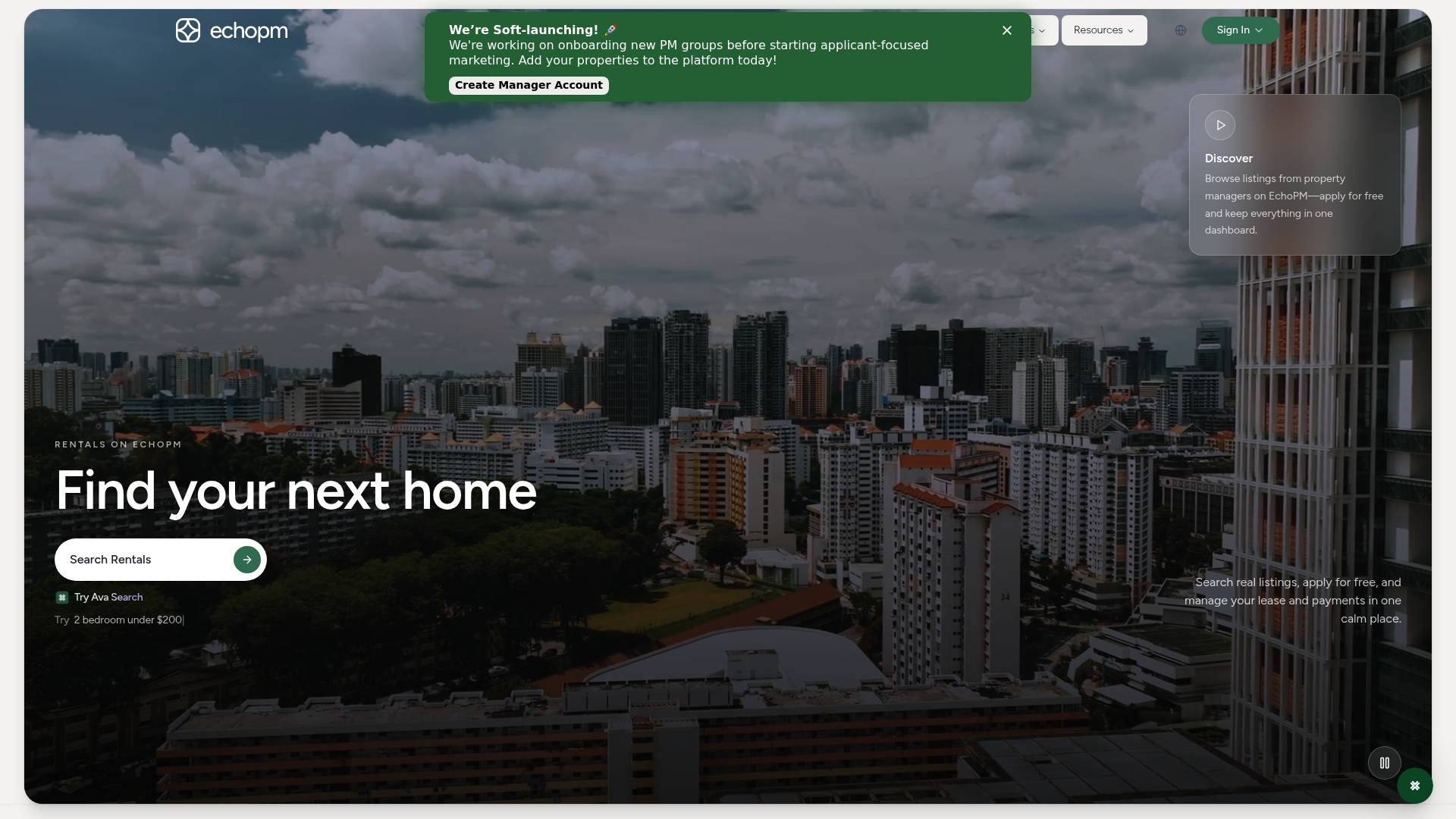
With Echopm, you get automated rent collection, maintenance workflows, real-time reporting, and tenant communication all in one platform. Lease applications, document signing, and screening are handled through the same system, so nothing falls through the cracks. Property managers who want to see how these features work in practice can explore the full platform and find the tools that match their portfolio size and workflow.
FAQ#
What is multi-property management?
Multi-property management is the centralized oversight of multiple rental properties using integrated systems for leasing, maintenance, communication, and financial tracking. The goal is consistent operations across all units without proportional increases in manual work.
How do you start automating a multi-property portfolio?
Start with the Revenue Layer by automating rent collection and lease renewals before adding maintenance or reporting tools. This phased approach delivers immediate cash flow benefits and builds team confidence for later stages.
Why are checklists critical in multi-property management?
Standardized checklists for turnovers, preventative maintenance, and issue triage prevent deferred maintenance and ensure every property receives the same level of care regardless of who does the work.
What is the biggest risk of managing multiple properties without a system?
The biggest risk is becoming the single point of failure. Without centralized communication, task ownership, and automated workflows, every decision and follow-up depends on you personally, which limits growth and increases errors.
How does multi-property management software improve revenue?
Portfolio-wide data consolidation allows property managers to spot vacancy trends, synchronize pricing across units, and automate financial reconciliation, all of which reduce lost revenue from manual errors and slow responses.